Translate

Thursday, 20 February 2014

A Simple Life

Day 75 in Rarotonga, Cook Islands.

It has been a long while since I have taken a real break from urban life and people. The last time I did a similar thing was when I took up a summer job in Northern BC. I only stayed there for a little less than three months. Even though the population of Muncho Lake was only 22 people, I was constantly surrounded by co-workers and tourists. I used to have long talks about anything and everything - troubles, dreams, hopes and aspirations. When I wanted solitude, I could always retreat to the vast forests and mountains on my days off. There was no internet or satellite TV. The VHS player had just started becoming a common home appliance.

Then life got more complicated and people were more wary of each other. Fewer heart-to-heart talks happened and they were few and far between. It got to a point that people would only contact me because they needed something from me or to reproach me. I might be living in a city of half a million people but I was more isolated than ever. Travelling was my only escape; I would forget the unworthiness that other people made me feel about myself. Maybe by chance, I would find my Shangri-la in my travels. Well, after my Trans-Siberian journey in 2011, I knew I was going to take more drastic actions to lead a simpler life in my golden years. I then developed a list of things that I was searching for.

The list of criteria for my utopia is as follows:
1) Warm all year-round, 18 - 32 degrees Celsius.
2) Not too dry or too humid. I prefer storms to continuous rainfalls.
3) Population density not higher than 100 people per sq. km.
4) At least 100 metres above sea level because global warming is real.
5) Not located in a major natural-disaster zone (e.g. the Ring of Fire)
6) Average education level of residents not lower than high school graduation.
7) Cost of living comparable to the Canadian average. If not, I should be able to live off the land.
8) Most locals can speak or understand English.
9) If religion is mandatory, I would prefer to be residing in a Christian community.
10) Reliable and cost-effective transportation is available to access the closest international airport.

Equipped with my list, I set out to find my heaven on earth in January 2013. I thought my final destination would be Cook Islands because it checked off almost all my criteria. After the setback in March 2013, I thought maybe I should also visit other islands that did not meet my basic requirements. I took a detour to visit South India, Sri Lanka, Malaysia and Indonesia in the fall of 2013. I am glad I took the time to check them out. I saw some amazing things and places, and was welcomed by some of the warmest people in the world. However, I just could not deal with crowded, chaotic places on a daily basis.

Returning to the present...There are roughly 13,000 people on the island of Rarotonga including locals, foreign workers and tourists. Even though the island is geographically remote, residents and visitors are not completely cut off from the rest of the world and enjoy modern conveniences. If it weren't for the constant sound of the waves, I would have felt like I was back in Vancouver in the summertime. Perhaps because tourism is the chief industry here, tourists are no strangers to the locals. Polynesians generally are friendly and caring. Well, the Rarotongans are the exception. They are only interested in the $$$ that the tourists bring into their economy. I have yet to find a Rarotongan who has taken time to chitchat with me.


I had hoped to settle on one of the outer islands in the Cooks. About three weeks ago, I realized that my dream of living here would not materialize because there is no reliable and/or scheduled inter-island transportation between Rarotonga and the other 11 islands. Item #10 on my list of criteria, therefore, cannot be checked off. The Cook Islands might have looked ideal on paper for a retirement place; the country is nonetheless riddled with a large number of deep-rooted socio-economic issues that even additional foreign aid and grants could not resolve in the near future. Sadly though, the reality is that there will be less foreign aid and grants.

Friday, 24 January 2014

Joy has left Rarotonga

It has been seven weeks since I arrived in Rarotonga, Cook Islands. For some strange reason, I have sensed little or no joy on this beautiful and supposedly "the happiest island in the South Pacific". At first I thought it could be because people were stressed out by the hype of the holiday season. Perhaps the locals would be happier after New Year's. Well, it is more than three weeks into 2014, and there is no sign of cheerfulness on the island.

On the day before Christmas Eve, I went to extend my visa at the Immigration Office, the lady on the other side of the counter told me about her oldest daughter's suicide two years ago. I asked my hostess about the incident. She replied that teenage suicides are very common in Rarotonga. Even the adults often feel "hopeless" living on this island. Most residents do not consider living here as a special gift from God. They want to live in New Zealand or Australia. As the saying goes, "The grass is always greener on the other side of the septic tank".

During many of my conversations with local papas and mamas, they have repeatedly raised concerns about their offspring resenting physical work, and turning to the bottle or other addictive habits for "relief". A week ago, the 10-year old girl next door let out blood-hurdling cries when her grandparents asked her to mow the lawn with a motorized lawn mower.This girl would otherwise play video games and/or watch movies 24/7 during her 6-week school break. Subsequently, the older generation is still toiling on their farms, yards and households while the younger generation pursues a hedonistic lifestyle.

Even though religion has a strong hold on the communities on Rarotonga, petty theft is prevalent. Lying and stealing are not being frowned upon. What could have been an island paradise is contaminated with greed, immorality and contempt for authority. Unless the young Rarotongans realize that the future is in their hands, build stronger work ethics, and shape up instead of ship out, social problems are going to plague this once "happiest island in the South Pacific".


Sunday, 8 December 2013

My Indonesian Journey - Temples, smoking, shopping and other things...

Indonesia Nov 12 - Dec 5, 2013

I have always thought Indonesia is just a group of islands that are constantly under the threat of natural disasters and civil unrests. When the tsunami hit Banda Aceh on Boxing Day 2004, I could not help but asked God why such catastrophe should fall upon these people. Well, my visit to Banda Aceh provided answers to questions in my mind.

Banda Aceh had a lot of social problems and power struggles before the disaster. This port city had been on an economical decline for the last couple hundred years. Because of all the fighting going on, the city was already crumbling except for the mosques in pre-Tsunami times. I was informed by the staff at the Tsunami Museum that most of the city was rebuilt after the disaster. The government and NGO's also built houses for the homeless people. Reconstruction of roads and houses are still evident everywhere in the city. Because there were few resources left behind to fuel the in-fights after the tsunami, talks of being an independent state ceased too.


The three islands that I visited during my Indonesian journey are Sumatra, Java and Bali. Sumatra is the second largest island of the 1700 islands in the Indonesian territories. Sumatra is now the chief producer of Indonesian coffee. Java is the most populous island where 100,000 year old Java Man skeleton was discovered. I visited the Sangiran Museum and learned much about the Java Man in relation to Homo Erectus and Homo Sapiens. The other two important historic sites on Java island are the Borobudur (Buddhist) Temple which is some 40 km west of Yogyakarta. About 17 km east of Yogyakarta is the Prambanan (Hindu) Temples. Other than being a UNESCO site, Bali is a world class vacation spot, renowned for its unique Hindu temples and beautiful beaches. The other four UNESCO sites in Indonesia, that I did not visit, (from West to East) are Tropical Rainforest of Sumatra, Ujung Kulon National Park, Komodo National Park and Lorentz National Park respectively.


The foreign exchange rates are quite different from the international currency markets. When I received 10,950 IDR for every 1 CAD in the first licensed money changer office that I went into in Jakarta, I was already very happy because I could only get 10,800 IDR per 1 CAD in Canada. You could imagine how delighted I was when I changed more CAD's in a local bank in Banda Aceh, and the exchange rate was 1 CAD to 13,000 IDR minus a 3% commission. The Indonesian government could lose a lot of money when they buy the foreign currencies from the banks.

Just when I thought smoking is prevalent in Malaysia, smoking is an integral part of Indonesian life. A pack of cigarettes costs less than $1.00 USD in Indonesia. In all my travels, I have not seen as many chain smoker drivers as in Indonesia. I should know because I was always assigned the front seats right behind the driver. Even though Philip Morris bought the leading cigarette company, Sempoerna out a few years back, the national brand, Dji Sam Soe still has the majority market share. The unfiltered, hand rolled, cut and packaged kredit cigarettes remain the most popular choice of the older Indonesian smokers. Kredit cigarettes are tobacco blended with cloves and other secret spices.


Bali has always been in the TOP TEN list for having the most beautiful beaches in the world. In spite of the onslaught of tourists, most places on the island are kept pretty intact from the outside world. I was swarmed by aggressive taxi drivers when I arrived in the bus terminal in Mengwi around 10 p.m. I walked to the nearest police station and asked for assistance. A handsome policeman drove me to my guesthouse in Kuta. Prices in Kuta are still relatively low given that there are so many world class resorts and 5-star hotels. Transportation is a major issue in Bali. Unless you rent a car, your travels are limited by the sporadic bus schedules.


In many ways, Indonesia has exceeded my expectations. Even though I have sworn not to buy any souvenirs on this trip, I could not help but bought 4 tops, 1 batik jacket, 1 batik sarong and 1 pair of leather sandals in Indonesia because they are so beautiful and inexpensive. One of these days, I will return and travel to the eastern islands of Indonesia.

Saturday, 7 December 2013

The Kingdom of Tonga

It would have been a typical South Pacific vacation in Tonga if a bicycle accident did not happen on the island of 'Eua on March 1st, 2013. My rented bike crashed to the side of a gravel road at the edge of a rainforest. The rest is history...
Tonga is made up of four groups of islands, with Tongatapu group in the South, Ha'apai in the middle, Vava'u in the north and Niuas in the far north. The capital is Nuku'alofa on the main island of Tongatapu. There are weekly ferries looping around Tongatapu, Ha'apai and Vava'u. The remote group of Niuas islands is only accessible from Nuku'alofa 3 times a year.


One of the reasons why I choose Tonga as one of my destinations is that it is a nation that was never colonised. However, it became a "protected state" of the British Empire. The reigning monarchy has absolute power over the parliament in the rule of the country. Even though majority of the young Tongans carry mobile phones these days, everyday life is still imbued in traditions.


I have jokingly coined the term "I-forgot-nation" for Tonga. Because religion is a great part of Tongan life, it is also an "I-for-God" nation. Unlike the rest of the world, there are no schedules and deadlines in their world. If things can happen, they will happen and there is no real push for anything to happen on time. If things don't happen, the typical response is "Sorry, I forgot."

Tongans might not be rich in monetary terms; however, they more than make up for it in "heart". Where would you see family members sleeping on the floor around the bed of a sick family member in a hospital overnight? Nurses encourage visits at all times and death is taken as seriously as birth. Tongans have shown me humanity at its best. May God protect and keep these wonderful people.

Aussie, Aussie, Aussie...Ya, ya, ya

My Australian experience had not been an easy one. I visited all its states except for Tasmania which was on fire. When I flew over the continent from Perth to Sydney, most of the land appeared to be burnt orange in colour with some green on the two coasts. The majority of the continent is indeed uninhabitable. The term "outback" covers vast land that is not the coastal region.  

Like Canada, it is blessed with an abundance of natural resources. It is also diverse in cultures. If Canada can be described as an autumn country, Australia is mostly a summer country. It has a lot more young people than Canada, and yet it is aggressively trying to attract young labourers from all over the world to work on its farms and mines by granting working tourist visas. As the Bible says, "The harvest is great but the labourers are few."

If I were to pick a favourite Australian city, it is a toss between Brisbane and Perth. Both cities have a river running through them, moderate climate, a deep harbour and beautiful sand beaches. Their transportation systems are well organized, much better than that of Vancouver. There are a lot more bikes on the road yet very few dedicated bike lanes and hence less traffic congestion. Their city planners have made provisions for population growth and urban expansion years ahead and it is evident in the infrastructure.

Most of the famous Australian landmarks are overrated especially the natural ones such as the Great Barrier Reef and Ayers Rock. As a Canadian visitor, I was comparing our nature to theirs. Ours are much better preserved and less crowded.  I do however have a particular fondness for the man-made landmarks such as the Sydney Opera House and the planned city of Canberra. In terms of wildlife, I did not have any close encounter with the kangaroos, koalas, emus, wallabies, etc. One thing that is abundant everywhere in Australia is flies. I swear I must have swallowed hundreds while visiting various national parks.


Even though Australia is an English-speaking country, Australian English is hard to understand. As with other young countries in the world, Australia is in the process of carving out a national identity that its people would be proud to call their own. It seems to me that Australians are more sports-oriented. Not many Australians know all the verses to their national anthem; cheers on Australia Day (January 26th) "Aussie Aussie Aussie/Oi Oi Oi/Ya Ya Ya" were heard loud and clear everywhere. 

A country that had tested me with its vast, burnt distances, its impenetrable slang, and its relentless flies had somehow won me over anyway. Like its people, Australia doesn't try too hard to impress you — it just is what it is, loud and sun-baked and unapologetically itself. 

Friday, 6 December 2013

Malaysia: A Puzzle Worth Solving

Malaysia Oct 24 - Nov 12, 2013

At the mention of the name Malaysia, one would conjure up images of a modern country which is a melting pot of many races. At one end of the spectrum are the pork-eating Malaysian-Chinese. The other majority group is the Muslim Malay. Malaysians share one common passion - food. I dare say the national food is noodles. From gourmet seafood char kuah teow to instant chicken-flavoured soup noodle, Malaysians love to eat spicy noodles any time of the day.


Even though Malaysia has very good infrastructure generally, a large part of the country remains isolated and rural, especially the northern part of Malay Peninsula and East Malaysia on Borneo. Travelling in these parts of the country certainly poses definite challenges for the independent travelers. I found myself waiting at bus stations, railway stations, ferry terminals and bus stands for endless hours because the schedules were mostly outdated and unreliable.


Malaysia appears to emphasize the nature aspect in its tourism promotional program. With the exception of the Lenggong archaeological site, the country has almost no ancient artifacts. Most buildings in the two UNESCO cities (Malacca & Georgetown) are no more than 200 years old. Perhaps more effort could be put in preserving its history. Penang is the only city that I witnessed the most restoration projects in progress.


If I have to choose my favorite place in Malaysia, I would pick Kuching as my top choice to be followed by Malacca and then Georgetown. Kuching has a beautiful waterfront, the most number of museums which are all free of charge, a wide range of shopping styles from modern malls to portable stalls, the most places of interest such as wildlife park and cultural villages, a large variety of food, a generally good public transportation system and affordable accommodation.


In comparison to its neighbouring countries in SE Asia, Malaysia is modern and its cities are just as world class as the major cities in the western world. For Australian and New Zealand tourists and water sport enthusiasts, Malaysia is such a bargain in comparison to their home countries as vacation spots, and most locals can speak English. For a history and architecture fan like me, my Malaysian journey provided answers to the many puzzles that I had about the enigmatic island of Borneo and a refresher geography lesson for the Malaya Peninsula.


Monday, 28 October 2013

Sri Lanka Oct 9 - 23, 2013

Before I came to Sri Lanka, I had high expectations of the place because of their government's extensive and intense international promotions of Sri Lanka as the idyllic vacation and retirement spot for westerners. Their tourism slogan has been "Sri Lanka - Land like no other". Well, what I experienced in the past two weeks does not exactly match its claims. Perhaps if I did not visit South India before coming here, the discrepancies would not have been so apparent.

It seems to me that Sri Lanka is a duplicate of South India with a stronger emphasis on Buddhism. I find Sri Lankans to be relatively more submissive and religious than South Indians. There is a high degree of mingling of the Buddhist community with all aspects of everyday life of the common people. Sri Lankans don't seem to mind being ruled by both the government and the monks. The monks appear to be rather powerful, and they forget that the sangha should not be closely connected to society outside the monastery walls except in the case of Tibet where the Dalai Lama is both the political and spiritual leader. The ritualistic practices of Buddhism in Sri Lanka somewhat impede progress; Sri Lanka remains one of the more conservative countries in Asia.

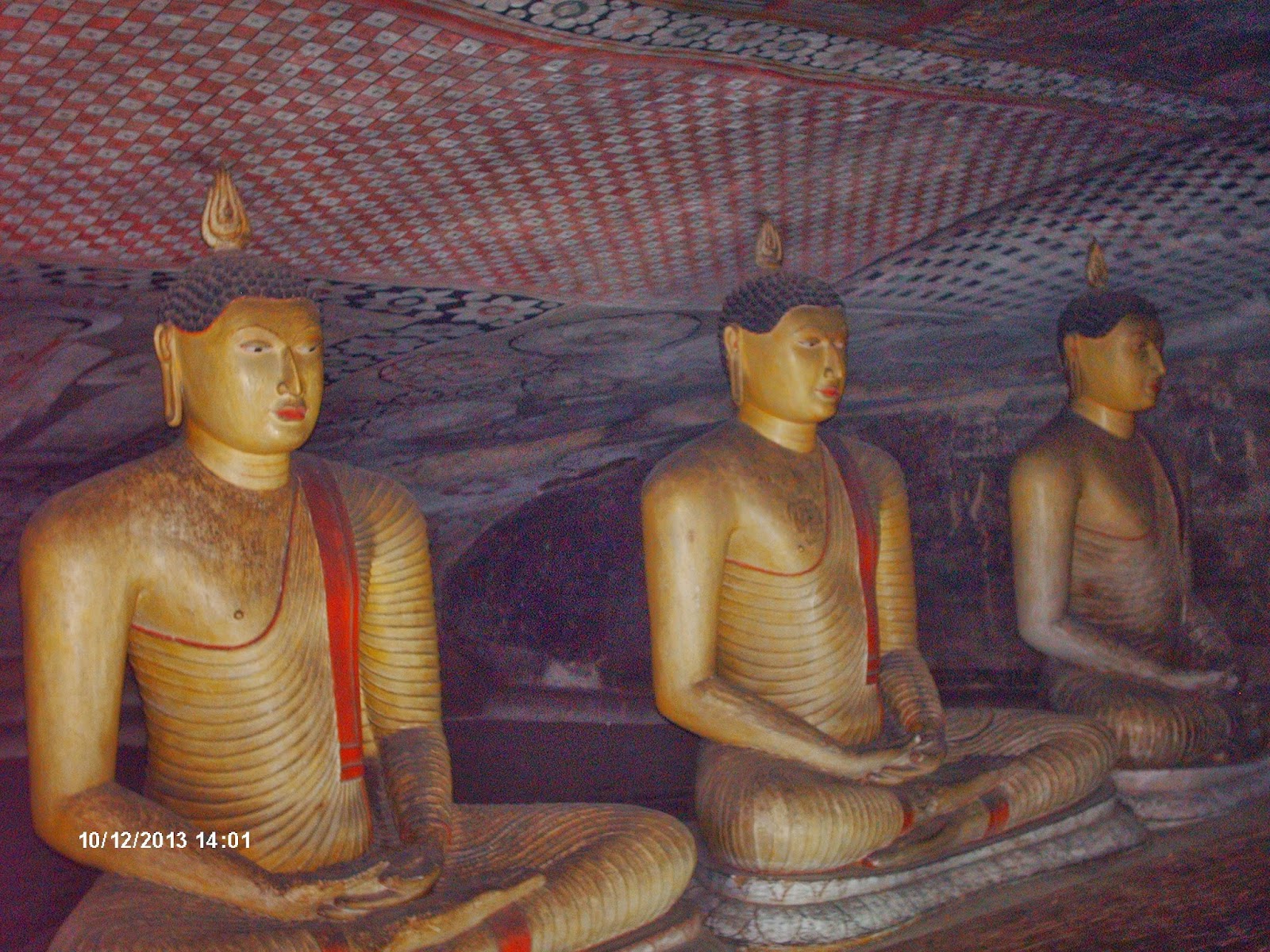
There are eight UNESCO sites in Sri Lanka and I have visited five of them on this trip. The first World heritage site that I visited was the City of Kandy which is a lakeside city that served as the last capital of the Sinhala kings before the British occupation. I then visited Dambulla for its Rock/Cave Temples. Only 20 kms east of Dambulla is Sigiriya where the remains of King Kassapa's Palace could be found on the slopes and summit of a 370 meter granite outcrop. Instead of continuing eastward to Polonnaruwa, Sri Lanka's second ancient capital in the 11th & 12th century, I went north to Anuradhapura, Sri Lanka's first ancient capital and saw the oldest certifiable tree on earth. I felt compelled to visit Jaffna where the 28-year old civil war started in 1981 and ended only in 2009. I was happy to see great progress being made in the re-building of this once vibrant city with predominantly Tamil residents. Two days ago I visited my fifth UNESCO site - Galle on the south coast. I have never seen so much Dutch colonial architecture anywhere else in the world.

Surprisingly, my favourite place in Sri Lanka is a "transit" place that I stayed for just one rainy day. I came down from Jaffna last Saturday to chill out for a couple days on the south coast before flying out to Malaysia. The last railway station in the hill country is Badulla. I walked around the city for about half an hour and decided that I did not like Badulla. So I rode the first outbound train to Ella, a quaint little town about an hour away from Badulla. I had penne carbonnara for lunch followed by a pot of Ceylon tea at their top hotel cafe in town. It was one of the best pasta that I have tasted in years. As I found out later, the chef actually went to Italy to learn how to cook pasta and pizza.

If I were to give any travel advice about Sri Lanka, I would say Sri Lanka is not developed enough for independent travellers. It is better to join a tour group. If you are here for R & R, then try to stay on the south coast. If you a trekking and/or nature enthusiast, then the hill country is your destination. If you are a history fan like me, then the golden triangle of Sigiriya, Anuradhapura and Polonnaruwa is the spot for you. There is a lot of beauty in every corner of this island country. It is really up to you to find your paradise on this island nation.