Translate

Monday, 28 October 2013

Sri Lanka Oct 9 - 23, 2013

Before I came to Sri Lanka, I had high expectations of the place because of their government's extensive and intense international promotions of Sri Lanka as the idyllic vacation and retirement spot for westerners. Their tourism slogan has been "Sri Lanka - Land like no other". Well, what I experienced in the past two weeks does not exactly match its claims. Perhaps if I did not visit South India before coming here, the discrepancies would not have been so apparent.

It seems to me that Sri Lanka is a duplicate of South India with a stronger emphasis on Buddhism. I find Sri Lankans to be relatively more submissive and religious than South Indians. There is a high degree of mingling of the Buddhist community with all aspects of everyday life of the common people. Sri Lankans don't seem to mind being ruled by both the government and the monks. The monks appear to be rather powerful, and they forget that the sangha should not be closely connected to society outside the monastery walls except in the case of Tibet where the Dalai Lama is both the political and spiritual leader. The ritualistic practices of Buddhism in Sri Lanka somewhat impede progress; Sri Lanka remains one of the more conservative countries in Asia.

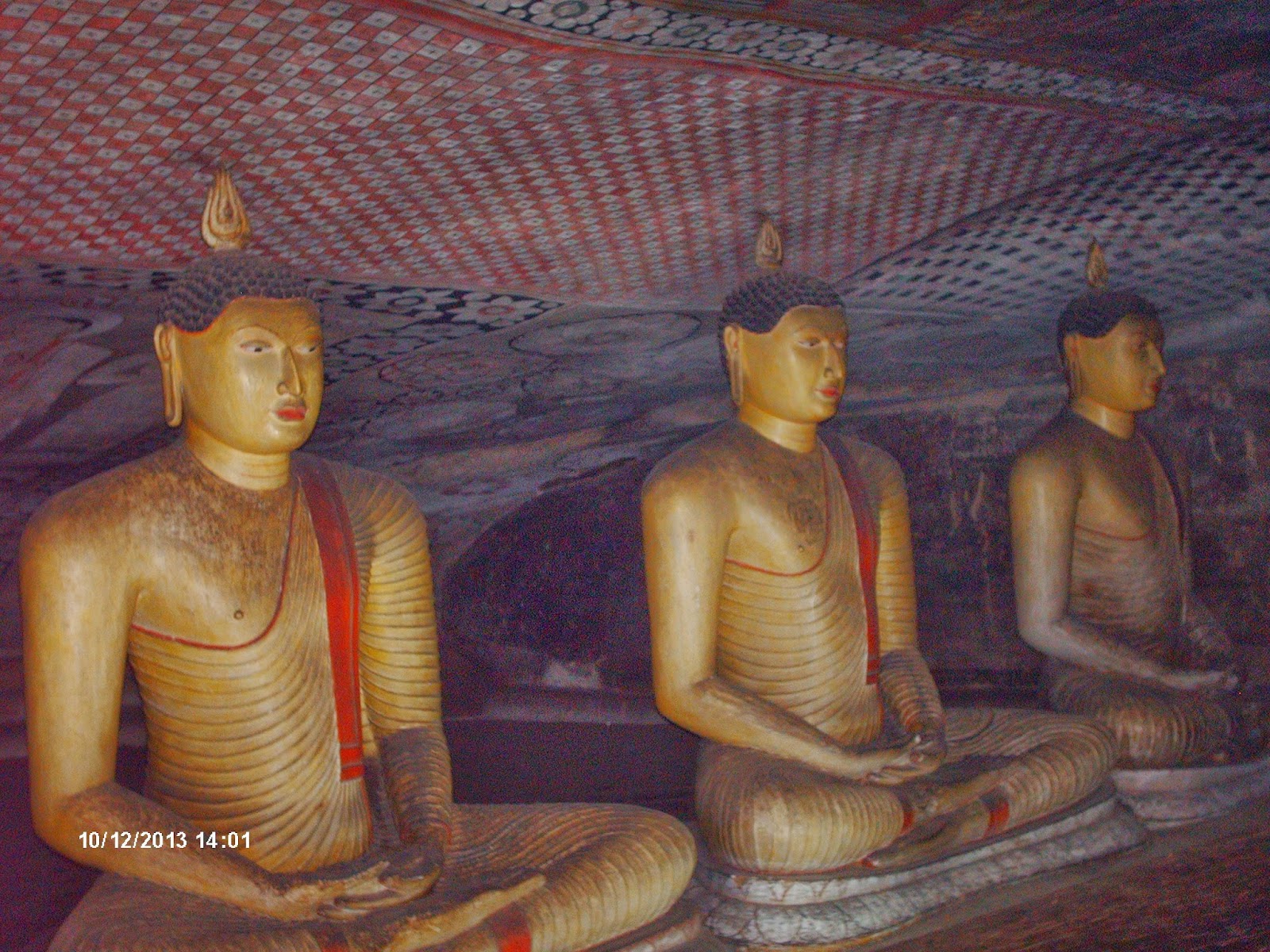
There are eight UNESCO sites in Sri Lanka and I have visited five of them on this trip. The first World heritage site that I visited was the City of Kandy which is a lakeside city that served as the last capital of the Sinhala kings before the British occupation. I then visited Dambulla for its Rock/Cave Temples. Only 20 kms east of Dambulla is Sigiriya where the remains of King Kassapa's Palace could be found on the slopes and summit of a 370 meter granite outcrop. Instead of continuing eastward to Polonnaruwa, Sri Lanka's second ancient capital in the 11th & 12th century, I went north to Anuradhapura, Sri Lanka's first ancient capital and saw the oldest certifiable tree on earth. I felt compelled to visit Jaffna where the 28-year old civil war started in 1981 and ended only in 2009. I was happy to see great progress being made in the re-building of this once vibrant city with predominantly Tamil residents. Two days ago I visited my fifth UNESCO site - Galle on the south coast. I have never seen so much Dutch colonial architecture anywhere else in the world.

Surprisingly, my favourite place in Sri Lanka is a "transit" place that I stayed for just one rainy day. I came down from Jaffna last Saturday to chill out for a couple days on the south coast before flying out to Malaysia. The last railway station in the hill country is Badulla. I walked around the city for about half an hour and decided that I did not like Badulla. So I rode the first outbound train to Ella, a quaint little town about an hour away from Badulla. I had penne carbonnara for lunch followed by a pot of Ceylon tea at their top hotel cafe in town. It was one of the best pasta that I have tasted in years. As I found out later, the chef actually went to Italy to learn how to cook pasta and pizza.

If I were to give any travel advice about Sri Lanka, I would say Sri Lanka is not developed enough for independent travellers. It is better to join a tour group. If you are here for R & R, then try to stay on the south coast. If you a trekking and/or nature enthusiast, then the hill country is your destination. If you are a history fan like me, then the golden triangle of Sigiriya, Anuradhapura and Polonnaruwa is the spot for you. There is a lot of beauty in every corner of this island country. It is really up to you to find your paradise on this island nation.


Saturday, 19 October 2013

South India, Sep 10 - Oct 8 2013

Although I had three months to plan my South India trip, I never drew up a detailed itinerary. My goals were simple: to visit the Ajanta and Ellora Caves, meet Amma on her 60th birthday, see Raja Raja's Big Temple, and gain a deeper understanding of ashram life. I watched many videos and read travel guide books to prepare for the visit. However, nothing could prepare me for the warmth and kindness that I experienced during those four weeks in South India.

From my last visit to North India, I learned to set aside many of my Western ideas about planning and control. Most Indians believe in karma and dharma. They have faith that if things are meant to take place, they will happen no matter what. I will give you an example that happened just a few days ago. I was in Chennai Sunday morning. I wanted to attend Sunday morning mass. I asked a young woman at the Chennai Egmore station which general direction should I be heading to go to the Basilica of Santhome. Well, before I knew it, a team of people worked out the route that I should be taking. There was always at least one person accompanying me along the way until I reached the Basilica. Faith plays an important role in many people's lives in India, and my desire to attend Sunday Mass seemed to inspire everyone I met to help me get there.

As with any journey, there are always ups and downs. I must admit, I had been lucky for the most part. Another example that came to mind was getting to Amma's ashram. The tuk-tuk driver took me to four hotels in Kayankulam and they were all fully occupied. I then asked him to take me to the ashram directly. He left me and my two bags on the other side of the lagoon. Because I couldn't swim, I hesitated to go on an old boat to cross the lagoon. Well, a family walked by and helped me to load and unload my bags. After I got to the other side, I was able to get dorm accommodation on the day before Amma's BD on Sept 27th. According to the residents of the ashram, there were close to 900,000 people attending the BD celebration. There were people sleeping on the ground uncovered everywhere at night during the 3-day celebration.

India evokes strong reactions in visitors. Its intensity can be overwhelming, but I have always found myself drawn to its energy and generosity. I tend to overlook the minor annoyances and love India and its people. It had been ten years since I first visited North India. I am happy to see that the quality of life has improved a great deal over the past decade. Most Indian tourists I met are well-educated and make a decent living. Even though they complain about a corrupt government, I believe that all that could be changed with the next generation of intelligent and honest Indian politicians. What impressed me most was not the temples, caves, or celebrations, but the kindness of ordinary people. Again and again, strangers stepped forward to help without expecting anything in return. More than any landmark, that spirit is what I remember most about South India.


Tuesday, 20 August 2013

Time is of Essence

Steam Clock in Gastown, Vancouver

I heard this story on the radio this morning...

Once upon a time in India, a beautiful young woman came up to a handsome philosopher in her village and said to him, "Marry me for you will not find another woman who loves you more in this village." The philosopher replied, "Let me think about this and I will talk to your father when I have a decision."

The philosopher pondered over the marriage proposal for a long time. He could only come up with an equal number of pros and cons. Then he remembered what his teacher taught him. He should opt for a path that would allow him to have new experience if he ever came upon a crossroad in his life. He went to the young woman's house and told the woman's father of this decision of marrying his daughter.  The older man shook his head and said, "Too late, my daughter is now happily married and is a mother of three children."

The philosopher went home and became very depressed. He died shortly after. Before he died, he burned all his books and writings except a small note on which he wrote "Half of my life was spent on reckoning and the other half regretting."

Well, a majority of the people I know also have many regrets in their lives. When asked if they would lead their lives the same way again, their answer has been a resounding "No". I often wonder how much more improved and regret-free their lifestyles could be if they have let their imagination run wild and acted on new ideas or opportunities. I suppose most people are afraid of failures and prefer to sit on the fence until the last obstacle is removed from their paths.

I made a wish on my 50th birthday that I will find my Shangri-La - a place where I am free to act on my ideas without hurting other living things. In about a month's time, I will be celebrating my 51st birthday. I don't think I can have a birthday cake in rural India but I will continue to wish for the same thing a year ago.

On Sept 24th, 2013, I was in Hospet waiting for a bus for 12 hours to go to Bangalore, and I had a piece of cake during the wait. The lady at Hospet railway station gave me a BD gift by selling me a sleeper ticket from Bangalore to Kayankulum when the train was fully booked.My birthday wish was to be able to say "Happy Birthday" to Amma on her BD, and it came true on Sept 27th at 10:30 p.m. when I hugged Amma.


Wednesday, 31 July 2013

Six Blind Men and an Elephant

Last week I went to pick up my Indian visa. On my way back home, I visited a newly opened eyewear store in downtown. I wanted to check out the price of a new pair glasses with progressive lenses. The sales clerk warned me that it would take a few weeks for my eyes to adjust to these lenses and I would have to turn my whole head to see sideways because there are blind spots inherent with progressive lenses. I smilingly replied, "It would not be a problem because I have no peripheral vision anyways. I have learned to turn my head to see sideways a long time ago."

I reflected on my answer and pondered about the parable of the "Six Blind Men and an Elephant". Even though things might be seemingly apparent to us, we cannot always be certain that we have the whole picture. More often than not we only have 2-D snapshots of the objects from where we stand, at best. When we apply the dimension of time, the same snapshot will look very different at another point on the time axis. This observation totally illuminates the Buddhist concept of "Change is the only constant in life".

As a self-proclaimed problem solver, I always try to add a disclaimer that my solutions are time sensitive. What might work now could be disastrous if applied at some point in the future. My original plan was to settle in the South Pacific at age 50 and lead a more isolated existence because I have lost much faith in humanity, especially in an urban setting. After the bicycle accident in Tonga this March and having returned home to Vancouver for a speedier recovery, my plans have changed drastically. I thought I should attempt to seek love and compassion again.

It would appear that South India has the highest concentration of spiritual gurus who advocate love and compassion. Back in December 2010, I took a virtual journey to South India. For a couple weeks, I visited several South Indian ashrams in my mind. I focused on comprehending the teachings, and meditated most of my waking moments. I came out of my virtual retreat refreshed and my physical health improved; however, I did not experience the love that I was looking for. Hopefully the upcoming South Indian visit will bring me inspirations and perspectives that I sought after in my previous virtual journey.


Friday, 14 June 2013

Sacred Places

In December 1999, I visited the Holy Land. Even though I studied a lot about this area for many years before my visit, I was still mesmerized by what I saw, heard and sensed. I went with a group of Christians who would be kneeling and praying every hundred yards or so because we were literally tracing the footprints of Jesus, seeing what Jesus must have seen a couple thousand years ago. Many of the sites were just ruins and yet visitors were frequently overwhelmed by the surreal ambiance. For instance, while we were riding on a boat modeled after a traditional fishing boat, sailing on the Sea of Galilee, it was drizzling softly. We could easily envision Jesus walking on water in the mist, calling out to us just like he did to his disciples.

Sea of Galilee
Bodh Gaya is the place where Sakyamuni became enlightened during a long meditation under a Bodhi tree. It was 105 degrees in the shade when I visited the Mahabodhi Temple in September 2003. Yet it was surprisingly cool and breezy when I walked by the offspring of that very tree. On the same trip, I also went to Tibet. I observed an unusual occurrence. No matter what kind of weather it was in the morning and early afternoon, it would always rain at 5 p.m. in Lhasa. In the early morning, the land was once again pristine. It was as though the unceasing veneration of the prostrating believers touched the Gods who in turn sent the rain to wash away the impurities and dirt every afternoon.

Mahabodhi Temple, Bodh Gaya
Bakhor Square, Lhasa
Machu Picchu is merely 2430 meters above sea level; yet clouds linger around the site constantly. Llamas roamed all over the place. It is commonly known as the Lost City of the Incas. I managed to have a picnic at a quiet corner in the lower part of the site. While eating my sandwich, I noticed a tiny bird perching on a rock not too far away. I threw a small piece of bread at him. He chirped for me. I threw another piece and he was singing away. Before I knew, I was in the middle of an ad hoc symphony performed by dozens of small birds all around me. The miracle part is that I am normally scared of birds. But I did not experience any fear or discomfort even when the number of birds got to be uncountable.


The magical moments of these sacred places captured my heart and mind. The indescribable peace that I encountered made me surrender to the higher power totally. I was united with my environment, and everything else was not important.

In March 2016, I visited the rock hewn churches in Lalibela, Ethopia. The churches are amazing engineering feat to bear witness to. What I experienced there made it a sacred place. One early morning, I attended a dawn service on top of St. George. Normally I would be too afraid to walk on uneven rock surface without holding onto some railings. There are no safety installations at the site but somehow that fear was lifted from my heart. I was very much at ease with the environment and hundreds of devotees.


Saturday, 18 May 2013

Game of Life

While recovering from my injuries in 2013, I played Scrabble all my waking hours, stopping briefly for meals and personal hygiene routines only. I was trying to avoid taking painkillers by exercising my brain and keeping myself mentally occupied. For many years, there were two boxes of Scrabble sitting on the shelf in the recreation room. However, nobody wanted to play the game with me. So I resorted to play online with strangers on Facebook. Even though I was never a big fan of arcade type of games, I had to play arcade games in between the Scrabble moves to keep me busy. I was beginning to understand why arcade games are so addictive. As with material possessions, players always have an urge to get to higher levels every time they play. It is an addiction that is common for all ages since things usually do not play out the way that people plan. Arcade games provide apparently provide escapes from reality.

Online Scrabble is a snapshot of our society today. People seem to forget that it is just a game. Everyone is there just to win. Some youngsters have turned it into a game of "filling the blanks". They have no idea how to spell words with more than four alphabets. A few men play Scrabble to solicit cyber sex. After all it is a women's game and there is a high concentration of females. Most of the female players are no ladies either. I have been called names that I would be too embarrassed to repeat them here. I also discovered that there were websites dedicated to help people cheat at Scrabble when I had to wait for hours until the other player came up with the next word. At the end of the day, my love for the game could not help me to overlook the vulgarity of the players. Then I remembered why those boxes of Scrabble were collecting dust on the shelf.


Wednesday, 8 May 2013

Tree of Life

The Tree of Life carries different meanings for different cultures. The symbol is ubiquitous.  This is a magnificent image of such symbol on a wall of Wat Xieng Thong in Luang Prabang, Laos.

One meaning is the propagation of human life. These days people are more into investigating their roots and the genealogy charts certainly resemble trees. The family trees intertwine with each from marriages and adoptions. This Eastern interpretation carries an connotation of finite time frame of earth's history. Ironically it goes hand in hand with creationism as suggested by the Judeo-Christian faith.

A second belief is that the tree of life represents the accumulation of wisdom and knowledge. This interpretation is taken from the Book of Genesis. There is a Tree of Knowledge in the centre of Garden of Eden. However, this idea collaborates with the Buddhist belief of birth and rebirth. There is no finite start or end of the earth. The cycles are intermingled among all living things, human, animal, fish, plant, etc. The pain and suffering in this life is attributed to the bad karma that I created in my past life. I nourish my tree of life by doing good deeds and learning from my life lessons.

During these injury recovery days, I have had more time to reflect upon both interpretations. I should hope that I lead a happier life because of the good karma that I have attained. When my physical form expires, I would like to have people remember me by the wisdom that I have gained.